If a selfclean oven door lock fails to open after the self clean cycle and sufficient cooling time has elapsed (approximately 1 hour), there are several things you can try.
- Unplug the unit or shut off the circuit breaker for 5 minutes. Plug the unit back in or turn on the circuit breaker. Set the clock and gently try moving the door lock lever (is so equipped) or opening the door.
- Set the self-clean cycle again and only allow it to work for 15 minutes. Cancel the self-clean cycle and allow the oven to cool. Gently try moving the door lock lever (is so equipped) or opening the door.
If these procedures fail to correct the condition, the lock must usually be accessed and moved manually to open the door.
*Note: Some model ovens require the oven door to be manually unlatched before the controls are returned to the OFF position or else the door may not be able to be unlocked. Check the owner's manual for proper operating procedures.
 Do not attempt to reinitialized a selfclean mode if any sort of error code is displayed on an electronic control. Doing so could create a potentially hazardous condition.
About Oven Door Locks
Most self cleaning ranges today use one of 3 different types of door locking systems. One design is solenoid driven, another is heat activated and the last, motorized.
- A solenoid controlled system can be identified by the lever that must be set to lock the door, plus a loud buzzing or clunking noise heard when locking or unlocking the door.
- The heat sensitive lock mechanism also has a locking lever but makes no noises. It instead utilizes a coiled spring to slowly lock the door as the oven heats.
- The motorized design has no lever to move, the motor locks the door by itself when the range is set for self clean. The motor may have made an audible whining or ratcheting sound when in use.
A motorized or heat sensitive style lock will usually be located beneath the cook top on free standing ranges. The cook top would usually need to be lifted to access the locking mechanism. On built in ovens, the oven must usually be removed from its enclosure (or at least partially) in order to remove the top panel to gain access to the locking mechanism. On some built in oven models, the lock assembly may be able to be accessed by removing the control console.
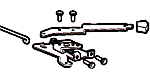 On the heat sensitive style (illustrated), there are no electrical parts used to operate the lock which could fail, so the whole mechanism will usually need to be replaced if not operational.
With the motorized lock mechanism, a volt/ohm meter is required to try to determine why the locking motor will not operate. The failure could be in the motor itself or the power supply leading to it, including a door activated and/or console mounted switch and switches on the latch mechanism itself.
On solenoid activated designs, the solenoid coil is a common failure point which is often mounted on the back of the range. On many of these models, the lock mechanism can be accessed by removing the rear panel of the appliance. Some models such as built-in ovens or drop-in/slide-in ranges, may have the mechanism mounted towards the front, under the top.
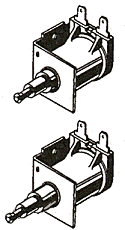 Failure of a solenoid style lock is most often caused by a bad solenoid. Once the lock is located, the solenoid coil can be checked for continuity. Some latch assemblies also have micro switches in the power supply that will need to be checked for faults too.
Be certain to unplug or remove power from the range before undertaking any repairs yourself and follow all standard safety precautions.
Based on an article supplied by www.ApplianceAid.com. Visit their site for more helpful appliance repair articles and tips.






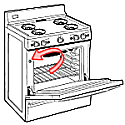 If you've interrupted the clean cycle by opening the door and the latch engaged and now the door can't be closed, there may be a door activated* switch on the front face of the oven. In this case you may need to manually press that door switch while at the same time canceling the clean cycle to get the latch to retract so the door can close fully again.